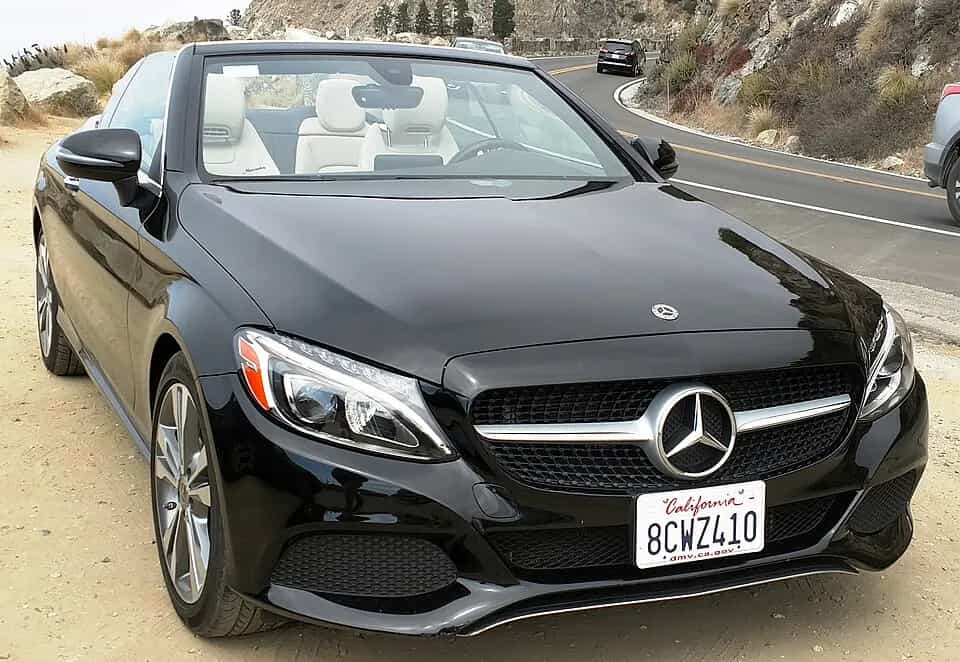
Mercedes-Benz C-Class Cabriolet
Importing a used Mercedes-Benz C-Class Cabriolet from the USA
The C-Class Cabriolet is Mercedes-Benz's four-seat soft-top on the C platform, and it sold in real volume across the United States, from the mild-mannered C300 to the thunderous C63 AMG. That gives European buyers a broad choice of clean, well-optioned cars. As an independent broker for used US vehicles, USCar Trader locates the right C-Class Cabrio in the States, verifies exactly what you are buying, and manages the move to Germany. Below you will find the generations, the engines, the US used-market picture and the full import process. If you plan to import a used C-Class Cabriolet from the USA, start here.

Model history: years and generations
The C-Class Cabriolet arrived on the A205 platform for the 2017 model year, filling the gap the previous CLK left behind. It shared its underpinnings with the W205 sedan and coupe and used a fabric soft-top that opens in about 20 seconds at speed. A facelift for the 2019 model year brought updated lighting, the newer MBUX-era interior touches and mild engine revisions. Production of this generation continued into the early 2020s before Mercedes reorganised its two-door line-up under the CLE badge, which effectively succeeds both the C-Class and E-Class convertibles.
Engines, transmissions and drive
In the US the volume seller was the C300 Cabriolet with a 2.0-litre turbo four (M264/M274) making roughly 241-255 hp, driving through a 9G-TRONIC 9-speed automatic to the rear wheels or 4MATIC all-wheel drive. Above it sat the Mercedes-AMG C43 Cabriolet with a 3.0-litre biturbo V6 (around 385-390 hp) and standard 4MATIC, and the range-topping C63 AMG Cabriolet with the 4.0-litre M177 biturbo V8, producing roughly 469 hp (C63) or 503 hp (C63 S), rear-wheel drive with a wet-clutch multi-speed gearbox. All are automatic; the AMG cars add an electronically controlled limited-slip differential.
Equipment lines and body styles
The body is a single four-seat convertible, but the engine ladder — C300, C43 and C63/C63 S — defines the character. Useful options include the AIRCAP wind deflector and AIRSCARF neck-level heating, the Burmester sound system, the panoramic-feel open cabin with heated seats, the AMG Night package and larger wheels. C43 and C63 cars with the AMG Driver's or Performance packages are the ones enthusiasts chase.
The US used market
Supply is plentiful. C300 Cabriolets from 2017 onward are everywhere and span a wide mileage range; AMG C43 and C63 examples are rarer but regularly available, often from warm states where a convertible makes sense year-round. Sun Belt cars from California, Florida, Arizona and Texas are typically rust-free and were frequently second cars with modest miles. Always confirm the soft-top opens and closes through a full cycle and that the AIRCAP and wind-deflector systems work.
Is an import right for you?
This suits a buyer who wants a specific spec — a loaded C63 S Cabriolet in a particular colour, or a 4MATIC C300 — that is scarce or expensive in Europe. It is a comfortable, usable four-seat convertible for everyday driving, with the AMG versions offering serious performance. Buyers set on a fixed roof should compare the C-Class Coupe instead.
Specs at a glance
| Item | Detail (by variant) |
|---|---|
| C300 engine | 2.0 L turbo inline-four |
| C300 output | approx. 241–255 hp |
| C43 engine | 3.0 L biturbo V6, approx. 385–390 hp |
| C63 engine | 4.0 L biturbo V8 (M177), approx. 469–503 hp |
| Transmission | 9G-TRONIC 9-speed auto (C300/C43); AMG MCT (C63) |
| Drive | RWD or 4MATIC AWD (C300/C43); RWD (C63) |
| 0–100 km/h | approx. 5.9 s (C300); approx. 4.1 s (C63 S) |
| Top speed | approx. 250 km/h (AMG, limited) |
| Roof | Fabric soft-top, opens on the move |
| Length | approx. 4686 mm |
| Width | approx. 1810 mm |
| Kerb weight | approx. 1680–1875 kg by engine |
| Fuel tank | approx. 66 L |
| Seats | 4 |
| Fuel | Petrol (premium) |
Common issues buyers should know
The C300's M264/M274 four-cylinder is generally dependable but can show oil weeps and, on higher-mileage cars, wear in the 9G-TRONIC valve body — check for clean, timely shifts. The C43's V6 is strong; the C63's M177 V8 is robust but demands strict oil-service discipline and healthy cooling. On any C-Class Cabrio, the soft-top hydraulics and the AIRCAP/AIRSCARF mechanisms are the most common convertible-specific faults, so cycle them fully. Also inspect the electronics — MBUX/COMAND glitches and a tired 12-volt battery are typical age-related items. Kept to schedule, C-Class Cabriolet reliability is sound.
Differences from the European version
US cars have a mph-led cluster, amber side markers and US lighting without a rear fog lamp, with headlights aimed to US standards. Connected services and navigation data are region-specific. The drivetrains match the European cars, so servicing is straightforward once the car is registered locally.
Import step by step
Selection of the right car and engine; VIN and plant/origin check with a history review; escrow payment releasing funds against documents; ocean freight (container recommended for a convertible) to Bremerhaven or Rotterdam; customs clearance; TÜV and individual approval where required; then German registration.
Customs and taxes: what applies
Remember: no origin proof, no 0% duty – and 19% German import VAT is due on every import.
The C-Class Cabriolet is built in Bremen, Germany, so its origin is European, not American. The 0% EU import-duty preference for US-origin vehicles under Regulations (EU) 2026/1455 and 2026/1461 therefore generally does not apply to this model; the standard third-country passenger-car customs rate (currently 10%) applies instead, always confirmed against the VIN and plant. Separately, the 19% German import VAT (Einfuhrumsatzsteuer) always applies on import and is calculated on its own. We list duty and VAT as distinct items and add no margin.
Modifications and single-vehicle approval
Typical work is fitting or activating a rear fog lamp, adapting the headlights to European aiming, and converting the speedometer display to km/h. The odometer must read in kilometres. A COC or individual approval documents compliance before TÜV sign-off and registration.
What to verify before buying
Verify the VIN against title and body; pull a Carfax or AutoCheck history for accidents, title brands and odometer consistency; cycle the soft-top and AIRCAP/AIRSCARF fully; confirm full Mercedes-Benz service records; check the title is clean, not salvage or rebuilt; on AMG cars assess brakes, tyres and any track use; and inspect the interior for water ingress around the folding roof.
Common questions
Can I import a used C-Class Cabriolet from the USA?
Yes. We source and verify the car, then handle freight, customs and the paperwork so it can pass TÜV and be registered in Germany.
Is the C-Class Cabriolet duty-free as a Mercedes?
No. It is built in Germany, so the US-origin 0% preference normally does not apply; the standard car customs rate plus 19% import VAT applies, confirmed from the VIN.
Which version should I import — C300, C43 or C63?
The C300 is the affordable everyday choice, the C43 adds a strong V6 with AWD, and the C63/C63 S is the V8 performance flagship. All import the same way.
What are common C-Class Cabriolet problems?
Soft-top and AIRCAP/AIRSCARF faults, 9-speed shift quirks on higher miles, minor oil weeps and age-related electronics. A pre-purchase inspection covers these.
Does the soft-top open while driving?
Yes. It opens and closes in around 20 seconds at low speed, and the AIRCAP system reduces buffeting.
Does the 19% import VAT always apply?
Yes. The German Einfuhrumsatzsteuer of 19% always applies on import and is shown separately from any customs duty.
Is a US C-Class Cabrio hard to register in Germany?
No. It needs a rear fog lamp, European headlight aiming and a km/h odometer, plus TÜV/individual approval.
Start with Mercedes-Benz in the Carhub, compare it with the C-Class Coupe, the CLE and the SLK-Class, or view current C-Class Cabriolet listings.